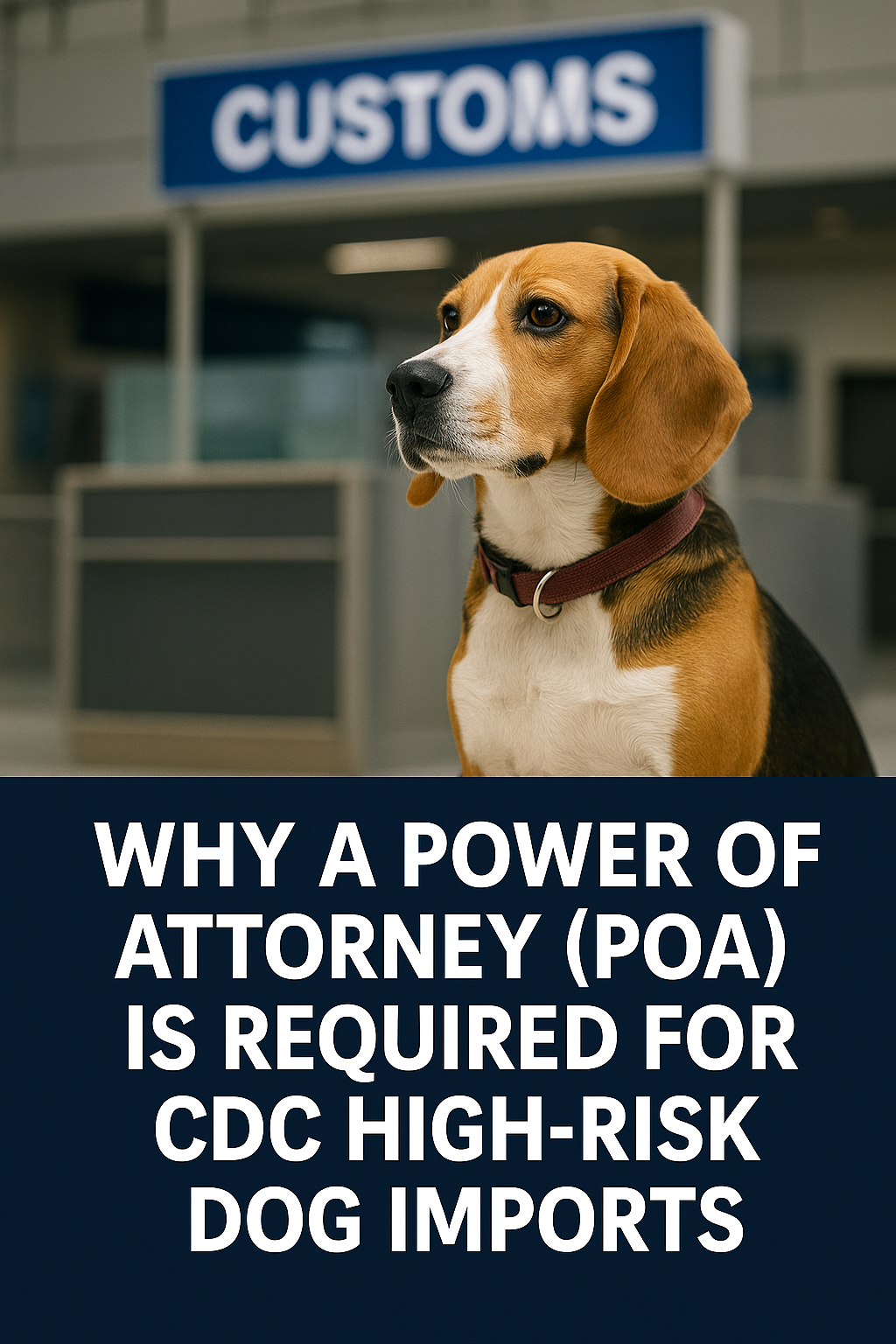
Why a Power of Attorney (POA) Is Required for CDC High-Risk Dog Imports

November 19, 2025

Share this article

Why a Power of Attorney (POA) Is Required for CDC High-Risk Dog Imports


When importing a dog from a CDC-designated high-risk rabies country, U.S. Customs and Border Protection requires that an authorized customs broker handle the official entry process. To legally allow a broker—such as A to Z Customs Brokerage—to act on your behalf, you must complete a Power of Attorney (POA).
This document gives your broker the authority to communicate with U.S. Customs, submit import documents, and ensure your dog is cleared safely and correctly into the country. Without a properly completed POA, CBP cannot release your pet, no matter how perfect the rest of your CDC paperwork is.
For pet parents, the POA may feel like “one more form,” but it plays a critical role in getting your dog through the border smoothly. The customs broker uses the POA to file entries, sign required declarations, and navigate the complex regulatory steps involved in bringing an animal from a high-risk country into the U.S.
The CDC’s rules are strict—especially since July 2024—and a POA ensures your broker can respond quickly if Customs or CDC officers need clarifications, additional documentation, or verification at the port of entry.
If you are a U.S. citizen , you must include your Social Security number at the top of the POA form ; this is a federal requirement that allows Customs to validate your identity and authorize the broker to act for you. Completing the POA fully and accurately protects you, your dog, and your broker—and speeds up the entire import process.
With this form in place, you’re one big step closer to getting your pup safely home.


Recent Posts

By VIV Builder August 24, 2026
Learn what to expect when picking up your dog at LAX cargo, including customs, CDC requirements, paperwork, and release procedures.
By VIV Builder August 17, 2026
Learn how to import a rescue dog through LAX with guidance on CDC rules, paperwork, customs, and safe arrival planning.
By VIV Builder August 10, 2026
Learn common causes of dog import delays at LAX and how proper planning, paperwork, and CDC compliance can help avoid problems.
By VIV Builder August 10, 2026
Learn how to export a dog from LAX, including health certificates, airline requirements, USDA documents, and international travel planning.
By VIV Builder August 3, 2026
Learn why a CDC-licensed animal care facility near LAX is important for international dog imports, customs, and safe pet arrivals.
By VIV Builder July 27, 2026
Learn what happens after your dog lands at LAX, including cargo, customs, CDC requirements, inspections, and the pet release process.
By VIV Builder July 20, 2026
Learn the CDC dog import rules for bringing your dog through LAX, including paperwork, rabies requirements, and arrival planning.
By VIV Builder July 13, 2026
Learn how to import a dog through LAX with guidance on CDC requirements, customs, paperwork, and arrival planning from Rue's Kennels at LAX.
December 13, 2025
Why a CVI Is Best Practice for Domestic Dog Travel (Even When the Airline Doesn’t Require One) When planning domestic travel with your dog, most pet parents focus on airline rules, crate sizes, and booking pet-friendly accommodations. One detail that often gets overlooked? The Certificate of Veterinary Inspection (CVI) —also called a health certificate . While many domestic airlines don’t require a CVI, obtaining one is still strongly recommended . Think of it like a seatbelt: you hope you never need it, but if something unexpected happens, you’ll be very glad it’s there. What Is a CVI? A Certificate of Veterinary Inspection (CVI) is an official document issued by a licensed veterinarian confirming that your dog: Is healthy Is free from signs of infectious disease Is up to date on required vaccinations (especially rabies) This document is time-sensitive and reflects your dog’s health status close to the date of travel. “If the Airline Doesn’t Require It, Why Bother?” Great question—and the answer is liability protection . While rare, incidents do happen during travel. In the unlikely event that your dog: Bites another animal Scratches or bites a person Is accused of being ill or contagious A CVI becomes your best line of defense . It shows that: Your dog was examined by a veterinarian Your dog was cleared for travel You acted responsibly and proactively as a pet parent Without a CVI, responsibility can quickly become complicated—and stressful. CVIs Protect You, Not Just Your Dog A CVI isn’t just paperwork; it’s documentation that can help protect you legally and financially. Should an incident occur, authorities or airlines may request proof that your dog was healthy prior to travel. Having a CVI on hand can: Reduce disputes Speed up resolution Prevent unnecessary quarantine or delays In short: it keeps a bad day from becoming a very expensive one . Best Practice = Peace of Mind Even when not required, obtaining a CVI is considered best practice by veterinarians, animal transport professionals, and experienced travelers. It’s a small step that adds a large layer of security. How Rue’s Kennels Can Help At Rue’s Kennels , we understand travel compliance inside and out. We can assist dog parents in obtaining a proper, valid CVI so you can travel with confidence—knowing you’re covered if the unexpected happens. Because the best trips are the ones where the only surprise is how many photos you take of your dog at the destination. �55357;�56382;✈️ 
April 27, 2025
Bringing your dog into the United States from another country can feel overwhelming if you’ve never done it before. There are rules, paperwork, deadlines, and government agencies involved. If you’re flying into Los Angeles International Airport (LAX), you’re coming through one of the few approved entry points for dogs arriving from countries considered high-risk for rabies. That makes preparation even more important.
Show More